
Choosing a driving school is one of those decisions that can look simple until you start comparing your options. Almost every Drivers Education Centre Toronto search brings up schools promising experienced instructors, flexible schedules, affordable packages, and successful students. But those claims alone do not tell you whether a school will actually help you become a safer, more confident driver.
The right driving program should do more than prepare you for a road test. It should teach you how to read traffic, manage risks, make sound decisions under pressure, and handle the situations Toronto drivers encounter every day.
For a first-time driver, this matters even more. Learning to drive in Toronto can involve busy intersections, streetcars, cyclists, pedestrians, multi-lane roads, highway traffic, winter conditions, construction zones, and unpredictable congestion. A student who only learns how to complete a test route may feel unprepared once they are driving independently.
This guide explains what to look for when comparing a Drivers Education Centre Toronto, how to assess instructors and training vehicles, what questions to ask before enrolling, and how to avoid common mistakes when choosing a driving program.
Whether you are a teenager starting from scratch, an adult learning to drive for the first time, or someone returning to driving after a long break, these considerations can help you make a more informed decision.
What Makes a Good Drivers Education Centre Toronto?
A quality driving school should have a clear teaching process rather than simply taking students onto the road and telling them what to do.
Good driver education typically develops skills in stages. A beginner may first learn steering, braking, acceleration, mirror use, signalling, and basic positioning. Once these become more comfortable, training can move toward lane changes, intersections, parking, traffic observation, highway driving, and more complex decision-making.
The instructor should explain why something is done, not simply tell the student what action to take.
For example, instead of saying, “Slow down here,” an experienced instructor may explain that the approach speed needs to change because visibility is limited and another road user could enter the intersection unexpectedly.
That difference is important. The goal is to develop judgment that the student can eventually use without an instructor sitting beside them.
A strong school should also recognize that students learn at different speeds. Some beginners become comfortable with vehicle control quickly but struggle with traffic judgment. Others understand traffic rules but become nervous when several things happen at once.
A good instructor adapts the lesson rather than forcing every learner through exactly the same routine.
Look Beyond the Price When Comparing a Driving School
Cost is naturally an important consideration, but the cheapest package is not always the most economical choice.
When comparing a driving school, look at what you actually receive for the quoted price.
Ask whether the package includes:
Two schools can advertise similar prices while offering very different amounts of actual training.
For instance, imagine School A offers a low-cost package with minimal in-car time, while School B costs slightly more but provides a structured program with additional practical instruction. If a student needs several extra lessons because the first program did not cover certain skills thoroughly, the cheaper option may eventually cost more.
The better question is not simply, “How much does it cost?”
Ask:
“What skills and support am I receiving for that price?”
That approach gives you a more realistic comparison.
Evaluate the Quality of the Driving Lessons
The quality of driving lessons can vary considerably between instructors, even within the same school.
Before enrolling, find out how lessons are structured.
A useful lesson should normally have a purpose. The instructor should know what skill the student is working on, observe performance, provide feedback, and gradually increase the level of difficulty.
For example, a lesson focused on lane changes might involve:
The instructor should also explain how the same process changes in heavier traffic.
This type of structured practice is much more useful than spending every lesson driving around without a defined learning objective.
Ask How Progress Is Measured
A good instructor should be able to tell you what you are doing well and what needs improvement.
Ask questions such as:
If the answers are vague, consider that a warning sign.
Choose Driving Classes That Match Your Learning Needs
Not every student needs the same type of instruction.
Some people benefit from traditional classroom learning. Others prefer online material that allows them to review concepts at their own pace. Practical in-car training is essential either way because knowing a rule and applying it in traffic are two different skills.
When evaluating driving classes, consider whether the educational material covers practical decision-making rather than simply memorizing road signs.
Useful learning areas can include:
A strong theoretical foundation can make practical lessons more productive because the student understands what the instructor is asking them to recognize.
Why Driver Education Toronto Should Include Real Toronto Conditions
Learning to drive in Toronto is different from learning in a quiet suburban area with light traffic.
Driver education Toronto students may eventually encounter dense traffic, complicated intersections, buses, streetcars, cyclists, pedestrians, delivery vehicles, parked cars, construction, and rapidly changing traffic conditions.
This means training should gradually expose students to realistic situations.
A beginner might start on quieter streets while learning vehicle control. Later lessons can introduce:
The progression matters.
Putting a nervous beginner immediately into extremely heavy traffic can create unnecessary stress. Keeping an experienced learner on empty residential streets for too long can also limit development.
An effective instructor increases difficulty as the student’s ability improves.
Consider the Instructor, Not Just the School Name
A school can have a good reputation, but the instructor you actually learn from will have the biggest influence on your day-to-day experience.
An effective instructor should be:
One of the most useful questions you can ask is:
“What happens when a student makes repeated mistakes?”
A good instructor should not simply become frustrated or take control of every situation. They should identify the underlying problem and create opportunities for the student to correct it.
For example, if a learner repeatedly forgets blind-spot checks, the instructor might break the lane-change procedure into smaller steps and practise it repeatedly until the sequence becomes habitual.
That is genuine teaching.
Driving School Toronto Reviews Can Help, But Read Them Carefully
Online reviews can provide useful clues when comparing driving school Toronto options, but they should not be your only source of information.
Look for patterns rather than isolated comments.
Reviews mentioning specific experiences are generally more useful than vague statements such as “great school.”
Pay attention to comments about:
Also remember that a review reflects one person’s experience. An instructor who worked well for a confident adult learner may not be the best fit for a very nervous beginner.
Use reviews as one piece of evidence rather than treating a star rating as the complete picture.
What to Look for in Driving Classes Toronto Programs
When comparing driving classes Toronto options, look for a program that balances knowledge, vehicle control, traffic awareness, and practical decision-making.
A useful training progression may look something like this:
Stage 1: Basic Vehicle Control
Students learn:
Stage 2: Fundamental Road Skills
Training can progress to:
Stage 3: Developing Traffic Judgment
Students begin dealing with:
Stage 4: Advanced Practical Driving
Depending on ability and program structure, training may include:
The important point is that progression should be based on competence rather than simply completing a predetermined number of lessons.
Why a Beginner Driving School Toronto Should Focus on Confidence and Judgment
A beginner driving school Toronto student often worries about making mistakes. That is normal.
Beginners are processing a large amount of information simultaneously: steering, mirrors, signs, traffic signals, speed, pedestrians, other vehicles, and instructor instructions.
A good instructor understands this cognitive load.
For example, a new driver approaching a busy intersection may know the traffic light rules perfectly but still struggle to scan the intersection properly. The solution is not necessarily more theory. The student may need repeated practical exposure until scanning becomes automatic.
Confidence should also be built carefully.
There is a difference between confidence and overconfidence.
A confident learner understands their limitations, leaves appropriate space, checks carefully, and makes deliberate decisions. An overconfident learner may assume they have mastered driving because they can control the vehicle.
The best beginner driving school Toronto programs should help learners develop the first type of confidence.
Check the Training Vehicle
The vehicle used during lessons matters.
Students should be learning in a properly maintained vehicle with controls and safety equipment in good working order.
Ask:
The vehicle should also provide a comfortable environment for learning. A nervous student can find it difficult enough to manage traffic without also struggling with unfamiliar or poorly maintained equipment.
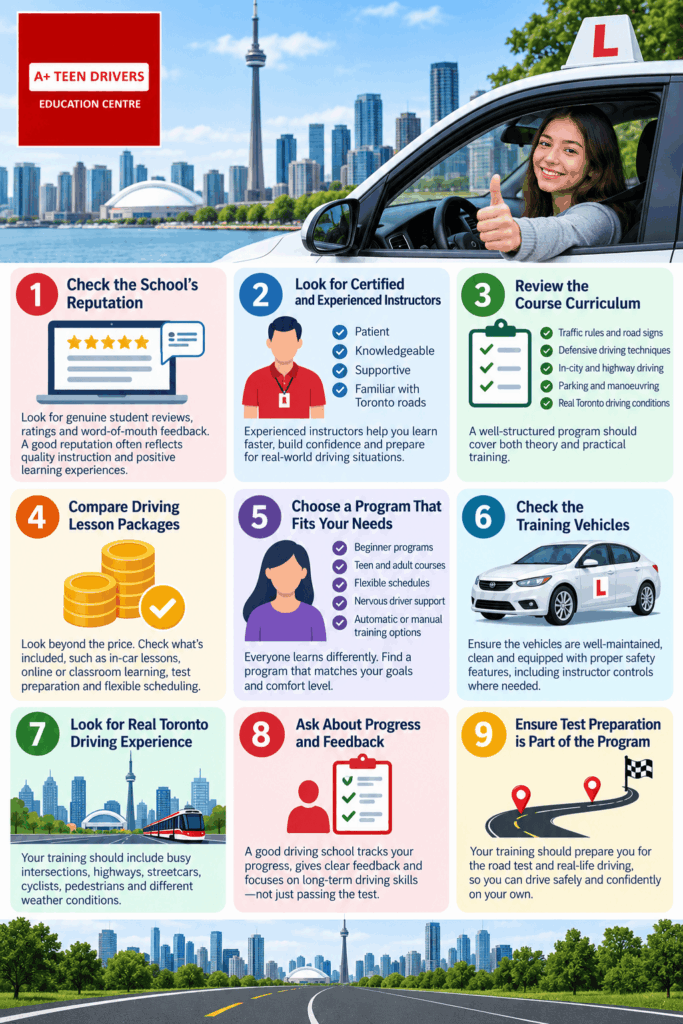
Understand the Difference Between Test Preparation and Driver Training
One of the most important distinctions when choosing a Drivers Education Centre Toronto is whether the school teaches driving or primarily teaches test performance.
Road-test preparation is useful. Students need to understand what will be assessed and practise the relevant skills.
However, test preparation should be part of a broader education.
Consider a student who memorizes a particular route and learns exactly where to perform certain actions. That student may perform well if everything happens as expected.
But real driving does not follow a memorized route.
Another driver may suddenly change lanes. A pedestrian may step toward a crossing. Traffic may stop unexpectedly. Construction may alter familiar road patterns.
The ability to respond safely requires understanding, observation, and judgment.
That is why good Toronto driver training should prepare students for situations beyond the examination.
Common Mistakes When Choosing a Driving School
Choosing Only Based on Price
A low price can be attractive, but compare lesson duration, curriculum, instructor quality, vehicle use, and additional fees before deciding.
Assuming More Lessons Always Mean Better Training
Quantity does not automatically equal quality.
Ten poorly structured lessons may be less useful than fewer lessons where the instructor actively identifies weaknesses and builds specific skills.
Selecting a School Without Speaking to Anyone
A short conversation can reveal a lot about how a school communicates.
Ask direct questions and see whether the response is clear and informative.
Treating the Road Test as the Final Goal
Passing the test is an important milestone, but it is not the end of driver development.
New drivers continue learning through experience.
Ignoring Schedule Compatibility
If lessons are constantly cancelled or difficult to book, learning momentum can suffer.
Choose a schedule that allows consistent practice.
Assuming Every Instructor Teaches the Same Way
Teaching styles differ.
If the instructor-student relationship is not working, ask whether changing instructors is possible.
Expert Tips for Getting More Value From Driver Training Toronto
Practise Between Lessons
If permitted and legally supervised, practise the skills introduced during lessons between sessions.
For example, if the lesson focused on parking, additional supervised practice can reinforce the sequence while it is still fresh.
Keep a Simple Mistake Log
After each lesson, write down two or three things that need attention.
For example:
This gives the next lesson a clear starting point.
Ask “Why?”
Do not hesitate to ask why an instructor recommends a particular action.
Understanding the reasoning helps transform instructions into usable driving knowledge.
Practise in Different Conditions
Once basic skills are established, supervised practice in different traffic environments can help build adaptability.
The objective is not to deliberately seek difficult conditions before you are ready. Instead, gradually expand your experience as your instructor or qualified supervisor considers appropriate.
Don’t Rush to the Road Test
Being legally eligible to take a test and being genuinely prepared are not necessarily the same thing.
If an instructor identifies recurring safety issues, address those issues before treating the test date as the priority.
How to Compare Toronto Driver Training Options
Before enrolling, create a simple comparison checklist.
| Factor | Questions to Ask |
| Instructor | Who will teach me and how experienced are they? |
| Curriculum | Is there a structured progression? |
| Practical training | What situations will I practise? |
| Vehicle | What vehicle will I use? |
| Scheduling | How easy is it to book consistent lessons? |
| Feedback | How is my progress assessed? |
| Cost | What exactly is included? |
| Test preparation | Is road-test preparation part of broader training? |
| Flexibility | Can lessons be adapted to my weaknesses? |
| Communication | Can I easily reach the school when I need help? |
This comparison can prevent you from making a decision based solely on advertising.
Final Thoughts on Choosing a Drivers Education Centre Toronto
The best Drivers Education Centre Toronto is not necessarily the one with the biggest advertisement, lowest package price, or highest number of reviews. It is the one that provides structured education, competent instruction, practical feedback, and progressive exposure to real driving situations.
Look for a school that treats driving as a skill to be developed rather than a test to be passed.
Pay attention to instructor quality. Compare what each package actually includes. Ask how progress is measured. Make sure the training reflects the realities of Toronto roads rather than relying entirely on memorized test routes.
Most importantly, choose a program that helps you understand the reasoning behind safe driving decisions.
Good driver training Torontos should leave you better prepared to make decisions when your instructor is no longer beside you. That is ultimately the real measure of successful driver education.
Whether you are researching driver education Toronto, comparing a driving school Toronto, or looking specifically for a beginner driving school Toronto, take the time to compare your options carefully. The right training experience can influence not only your ability to pass a road test, but also the habits and judgment you carry with you for years of independent driving.
Frequently Asked Questions
1. How do I choose the best Drivers Education Centre Toronto for a beginner?
Start by comparing instructor quality, curriculum structure, lesson content, vehicle condition, scheduling, pricing transparency, and student feedback. For a beginner, instructor patience and teaching ability are particularly important because the student is developing fundamental habits.
Ask how the school handles nervous learners and repeated mistakes. A strong program should gradually increase difficulty instead of overwhelming a new driver.
2. How many driving lessons will I need?
There is no universal number because students begin with different levels of experience and develop skills at different speeds.
Someone who has never operated a vehicle will generally need more instruction than someone who already has substantial supervised practice. Your instructor should be able to identify specific weaknesses and explain what needs improvement rather than promising that a fixed number of lessons guarantees readiness.
3. Is Toronto driver training useful if I already know how to drive?
Yes. Experienced drivers can still benefit from structured instruction, particularly if they learned informally, have developed poor habits, or are unfamiliar with Toronto’s traffic environment.
An instructor can identify issues that drivers may not notice themselves, such as inconsistent observation, poor lane positioning, inadequate following distance, or rushed decision-making.
4. Should I choose a beginner driving school Toronto program or private lessons?
It depends on your experience and learning needs.
A structured beginner program can be useful for someone starting from zero because it provides a progression from fundamental skills to more complex traffic situations. Individual lessons can be particularly useful when a learner has specific weaknesses or needs flexible scheduling.
For many students, combining structured instruction with appropriate supervised practice provides a strong learning approach.
5. What should I do if I am nervous about driving in Toronto?
Tell your instructor at the beginning.
Nervousness is common among new drivers, and hiding it can make lessons less productive. A good instructor can begin in a lower-pressure environment and gradually introduce more complex situations.
Focus on one skill at a time. As vehicle control becomes more automatic, you can devote more attention to traffic observation and decision-making.

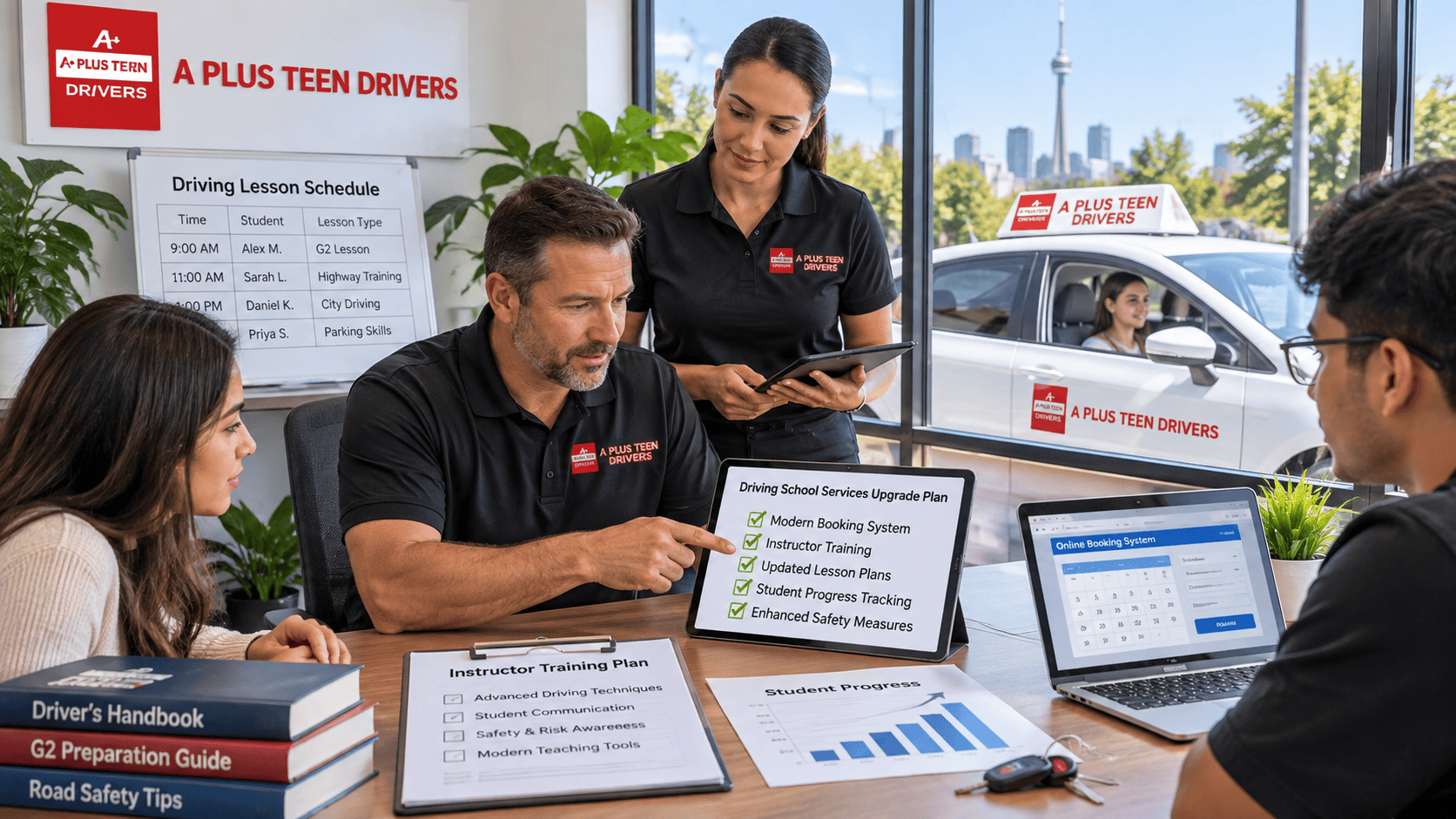
How Many Driving Lessons Do You Need Before Your G2 Test in Toronto?
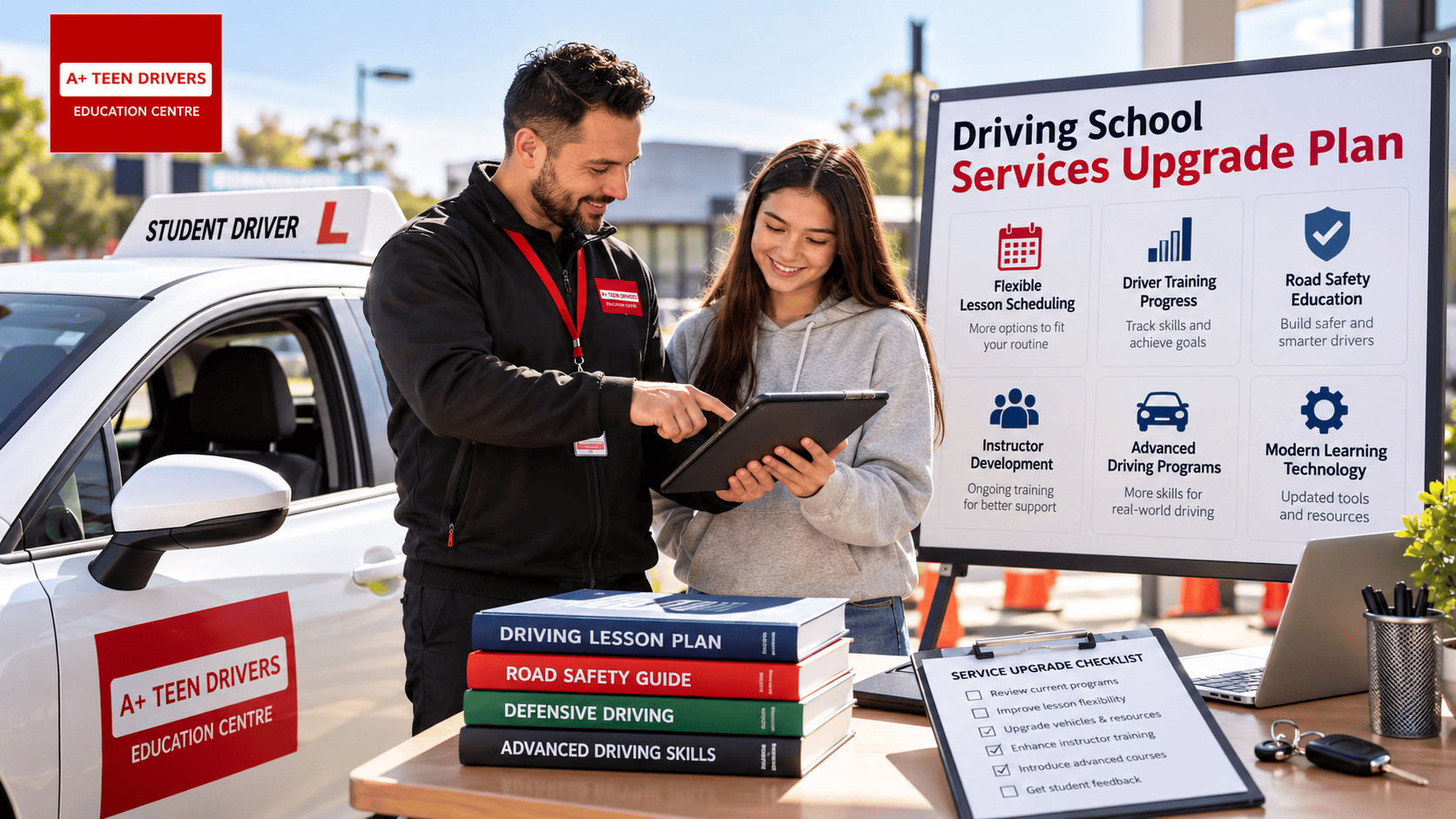
How Professional Driving Instructors Help Build Confident Drivers
How to Choose the Best Driving School on St Clair: A Complete Guide


 Trustindex verifies that the original source of the review is Google.
  Trustindex verifies that the original source of the review is Google.
  Trustindex verifies that the original source of the review is Google.
 Trustindex verifies that the original source of the review is Google.
  Trustindex verifies that the original source of the review is Google.
  Trustindex verifies that the original source of the review is Google.
  Trustindex verifies that the original source of the review is Google.
  Trustindex verifies that the original source of the review is Google.
  Trustindex verifies that the original source of the review is Google.