
For many Toronto drivers, learning to drive is not simply about passing a road test. It is about developing the judgment to handle heavy traffic, unpredictable road users, winter conditions, complex intersections, parked vehicles, cyclists, pedestrians, and constantly changing road environments.
That raises an important question: Should you take regular driving lessons, defensive driving training, or both?
The answer depends on your experience, goals, and current driving ability. Regular lessons are designed to build the fundamental skills needed to operate a vehicle safely and meet licensing requirements. Defensive driving goes a step further by teaching drivers how to anticipate hazards, identify risks early, create space, and make safer decisions when other road users make mistakes.
For someone searching for the Best Defensive Driving Classes Toronto, understanding this difference can help you choose training that actually matches your needs rather than simply selecting a course because it has a convenient schedule or attractive advertising.
In this guide, we compare regular driving lessons with defensive driving, explain where each approach works best, and explore how Toronto-specific driving conditions influence the decision.
What Is Defensive Driving?
Defensive driving is a proactive approach to operating a vehicle. Instead of concentrating only on your own actions, you continuously assess what other road users might do and prepare for potential hazards.
A defensive driver asks questions such as:
This mindset is particularly useful in Toronto, where traffic patterns can change quickly.
Defensive driving techniques commonly include:
The objective is not to make a driver overly cautious or nervous. It is to make the driver’s decisions more predictable, deliberate, and risk-aware.
Regular Driving Lessons: What Do They Teach?
A traditional driving school program generally focuses on building the foundational skills necessary to become a competent licensed driver.
For a new driver, this foundation is essential.
Regular lessons may cover:
A qualified driving instructor also provides something that independent practice often cannot: immediate feedback.
For example, a new driver may believe they are checking their mirrors sufficiently. An instructor can observe their actual behaviour and point out that mirror checks are inconsistent, too brief, or happening too late.
That feedback loop is valuable because driving habits develop quickly.
When Regular Driving Lessons Are the Better Starting Point
Regular lessons are usually the appropriate first step for:
Defensive driving concepts can be introduced during these lessons, but a learner generally needs basic vehicle control before they can effectively apply advanced hazard-management strategies.
Driving Lessons vs. Defensive Driving: The Core Difference
The simplest way to understand the difference is this:
Regular driving lessons teach you how to drive the vehicle. Defensive driving teaches you how to manage risk while driving the vehicle.
There is significant overlap between the two.
For example, both may teach proper following distance. However, the emphasis can differ.
A regular lesson might explain the importance of leaving enough space between vehicles.
Defensive driving training goes further. It teaches the driver to consider:
This distinction becomes particularly important after a driver has developed basic vehicle-control skills.
How Defensive Driving Helps on Toronto Roads
Toronto presents a combination of driving conditions that can challenge even experienced motorists.
Dense urban traffic means drivers frequently interact with:
The road environment can change within seconds.
A driver who focuses exclusively on the vehicle immediately ahead may miss a pedestrian approaching a crossing or a cyclist entering a blind spot.
Defensive driving encourages broader visual scanning.
Urban Intersections
Intersections are among the most important places to apply defensive driving.
Before proceeding through an intersection, an experienced driver considers more than the traffic signal. They also observe:
This does not mean stopping unnecessarily at every intersection. It means maintaining awareness and being prepared to respond appropriately.
Heavy Traffic
Toronto congestion creates another challenge: frequent braking and acceleration.
In stop-and-go traffic, drivers who follow too closely may repeatedly brake hard. This reduces reaction time and increases the likelihood of a rear-end collision if traffic stops suddenly.
Defensive driving encourages smoother speed management and a reasonable buffer.
Defensive Driving Techniques Every Toronto Driver Should Develop
Whether you are a new driver or have years of experience, several defensive driving techniques provide practical benefits.
1. Look Beyond the Vehicle Ahead
Do not focus only on the brake lights immediately in front of you.
Try to observe several vehicles ahead when visibility allows.
If traffic several cars ahead is slowing, you may have an opportunity to ease off the accelerator early rather than making a sudden stop.
This improves comfort and gives you more time to react.
2. Maintain a Practical Following Distance
Following too closely is one of the most common driving mistakes.
A proper gap gives you additional time to:
Remember that a distance that feels adequate in dry conditions may not be sufficient on snow, ice, or wet pavement.
3. Make Blind-Spot Checks Routine
Mirrors do not eliminate blind spots.
Before changing lanes, a driver should use the appropriate mirror checks and physically check the relevant blind spot when necessary.
This becomes especially important around:
4. Anticipate Other Drivers’ Mistakes
Defensive driving does not assume every driver will behave perfectly.
A vehicle drifting toward a lane line may be about to change lanes.
A driver approaching an intersection at excessive speed may not stop as expected.
A parked vehicle may pull into traffic.
The correct response is not to panic. It is to recognise the developing risk early enough to respond smoothly.
How an Established Driving School in Toronto Can Help
The quality of instruction matters because defensive driving is partly about decision-making, not simply memorising rules.
An Established Driving School in Toronto can provide structured practice in real traffic environments while giving learners feedback on their behaviour.
Good instruction should help a student understand why a particular decision is safer, rather than simply saying, “Do this because that is the rule.”
For example, instead of teaching a learner to maintain a particular position mechanically, an instructor can explain how road position affects visibility, turning space, cyclists, parked vehicles, and other road users.
That context helps students transfer the skill to situations they have not encountered before.
Defensive Driving Training for New Drivers
A new driver does not necessarily need to complete a separate defensive driving program immediately.
The most effective progression is often:
Basic vehicle control → road awareness → hazard recognition → defensive decision-making → independent driving
Once a learner can comfortably control the vehicle, defensive driving concepts become much easier to apply.
For example, a beginner who is still concentrating heavily on steering may struggle to monitor several hazards simultaneously.
After vehicle control becomes automatic, more mental capacity becomes available for:
This is one reason experienced instructors typically build skills progressively rather than overwhelming beginners with advanced concepts on their first lesson.
Defensive Driving for Experienced Drivers
Defensive driving is not only for beginners.
An experienced driver may benefit from training if they have developed habits such as:
Familiarity can sometimes create complacency.
A driver who travels the same route every day may stop actively scanning because the road feels predictable. Defensive driving training can help restore deliberate observation and hazard awareness.
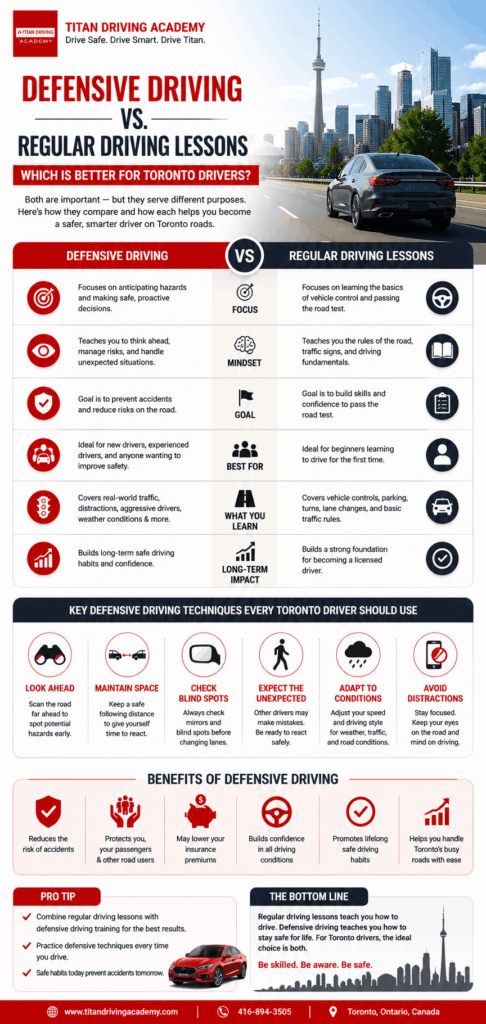
Which Is Better: Defensive Driving or Regular Driving Lessons?
There is no universal winner.
The better option depends on the driver.
| Driver Situation | Better Starting Point |
| Complete beginner | Regular driving lessons |
| Learner preparing for a road test | Regular driving lessons + defensive techniques |
| Newly licensed driver | Defensive driving |
| Experienced driver with poor habits | Defensive driving training |
| Driver returning after years away | Refresher driving lessons |
| Driver nervous in heavy traffic | Structured lessons + defensive training |
| Driver wanting stronger hazard awareness | Defensive driving |
| Driver wanting both skills and risk awareness | Combination of both |
For most learners, the strongest approach is not choosing one over the other.
Instead, combine foundational instruction with defensive-driving principles.
Driving School Instruction Should Go Beyond Road-Test Preparation
Passing a driving test is an important milestone, but it is not the final measure of driving competence.
A driver can technically perform the required manoeuvres during an examination and still lack the experience needed to deal with unexpected situations.
This is why quality driving lessons should include practical decision-making.
For example, a learner should understand not only how to change lanes but also:
These are real-world skills that continue to matter long after the road test.
Common Misconceptions About Defensive Driving
“Defensive driving means driving extremely slowly.”
Not necessarily.
Defensive driving means choosing a speed appropriate to the circumstances.
Driving significantly below surrounding traffic without a valid reason can create its own risks. The objective is controlled, predictable driving rather than simply slow driving.
“Experienced drivers do not need defensive training.”
Experience helps, but it does not automatically eliminate unsafe habits.
Even experienced motorists can benefit from identifying blind spots in their own driving behaviour.
“Defensive driving is only useful during bad weather.”
Weather increases risk, but defensive driving applies year-round.
Hazard awareness is relevant during clear summer conditions, busy rush hour, construction, nighttime driving, and every other road environment.
“Defensive driving is mainly about reacting quickly.”
A major principle is actually the opposite.
Good defensive driving tries to identify hazards early enough that an emergency reaction becomes unnecessary.
Practical Strategies for Becoming a More Defensive Driver
You can begin improving your driving habits without waiting for a formal course.
Use a Forward-Scanning Habit
Regularly shift your visual attention between:
Avoid staring at one location for too long.
Create Space
Whenever practical, avoid positioning your vehicle unnecessarily close to other vehicles.
Space gives you options.
If another driver makes an unexpected move, additional space can provide valuable time to respond.
Adjust to Conditions
Do not treat the posted speed limit as the only factor determining an appropriate speed.
Consider:
Minimise Distractions
A defensive driver needs attention available for the road environment.
Avoid unnecessary phone interaction and other activities that divert visual, manual, or cognitive attention from driving.
Expert Tips: What New Toronto Drivers Should Practise Most
From a practical training perspective, several habits deserve particular attention.
Practise Observation Before Reaction
Do not wait until a hazard is immediately in front of you.
Train yourself to notice potential problems early.
Learn to Read Traffic Behaviour
Brake lights, lane positioning, vehicle speed, wheel direction, and driver positioning can provide clues about what may happen next.
These clues are not guarantees, but they help you anticipate developing situations.
Avoid “Winning” Against Other Drivers
If another motorist wants to merge aggressively, accelerating to prevent them from entering your lane may turn a minor inconvenience into a dangerous situation.
Defensive driving prioritises safety over proving who has the right of way.
Treat Winter as a Different Driving Environment
Toronto winters can dramatically change braking, traction, visibility, and vehicle control.
Drivers should adjust speed, following distance, steering inputs, and braking behaviour to the actual conditions rather than relying on dry-road habits.
How to Choose the Best Defensive Driving School Toronto Drivers Can Trust
If you are comparing providers, do not evaluate them solely on price.
Look for evidence of:
The best defensive driving school Toronto drivers choose should help learners understand real-world decision-making rather than simply memorising information.
Ask what the training actually includes.
A course described as “defensive” should ideally explain how it develops hazard recognition, anticipation, space management, speed control, and decision-making.
When Should You Take Defensive Driving Training?
There is no single perfect point.
Consider defensive driving training if:
For new drivers, defensive concepts can be introduced progressively during regular lessons and reinforced through additional training once the basic skills are established.
The Best Approach: Build Skills, Then Build Judgment
Regular lessons and defensive driving should not be viewed as competing philosophies.
They solve different parts of the same problem.
Regular instruction establishes the mechanical and procedural foundation of driving. Defensive driving develops the mental framework needed to manage uncertainty.
Think of it this way:
Regular lessons answer:
“How do I perform this driving task correctly?”
Defensive driving answers:
“What could go wrong here, and how can I reduce the risk before it happens?”
A capable Toronto driver needs both.
Conclusion: Which Is Better for Toronto Drivers?
Regular driving lessons and defensive driving serve different purposes, so choosing one as universally “better” oversimplifies the issue.
If you are learning from scratch, start with structured driving instruction and build strong vehicle-control fundamentals. As your confidence and competence develop, incorporate defensive driving principles that improve hazard recognition, anticipation, space management, and decision-making.
If you are already licensed, defensive driving training can help strengthen the skills that are often underdeveloped after the road test.
For Toronto drivers dealing with busy intersections, dense traffic, pedestrians, cyclists, changing weather, and unpredictable road behaviour, the strongest goal is not merely learning how to operate a car. It is learning how to anticipate what may happen next and respond safely.
That is ultimately what separates basic driving ability from confident, responsible road behaviour—and why choosing the best defensive driving school Toronto drivers can genuinely benefit from should be based on the quality and practical relevance of the training, not simply the name of the course.
FAQ: Defensive Driving vs. Regular Driving Lessons
1. Are defensive driving classes better than regular driving lessons for beginners?
Not necessarily. Beginners generally need foundational instruction first, including vehicle control, steering, braking, lane positioning, turns, parking, and traffic procedures. Defensive driving principles can then be integrated into those lessons.
A beginner who is still struggling to control the vehicle may find advanced hazard-management concepts difficult to apply. Once basic control becomes more comfortable, defensive driving becomes significantly more useful.
2. Can defensive driving training help an experienced driver?
Yes. Experienced drivers can develop habits without realising it. Common examples include following too closely, checking mirrors inconsistently, braking late, or becoming complacent on familiar routes.
Defensive driving training provides an opportunity to reassess those habits and replace automatic reactions with more deliberate risk assessment.
3. What defensive driving techniques are most useful in Toronto?
Several are particularly valuable: maintaining adequate following distance, scanning beyond the immediate vehicle ahead, checking blind spots, anticipating lane changes, managing speed according to conditions, and maintaining awareness around pedestrians, cyclists, buses, streetcars, and congested intersections.
Winter conditions also make space management and smooth vehicle control especially important.
4. Should I take defensive driving training after passing my road test?
It can be worthwhile, particularly if you are newly licensed. Passing a road test demonstrates that you can meet the requirements of the examination, but independent driving exposes you to a much wider range of unpredictable situations.
Defensive training can help bridge the gap between test preparation and real-world driving.
5. How do I choose the best defensive driving school Toronto learners can rely on?
Look beyond advertising claims. Ask about instructor qualifications, lesson structure, practical road training, hazard-perception instruction, local driving experience, and how the program handles different learner abilities.
A reputable provider should be able to clearly explain what students will learn and how those skills transfer to everyday driving.


How Many Driving Lessons Do You Need Before Your G2 Test in Toronto?

How Professional Driving Instructors Help Build Confident Drivers

How to Choose the Best Driving School on St Clair: A Complete Guide


 Trustindex verifies that the original source of the review is Google.
  Trustindex verifies that the original source of the review is Google.
  Trustindex verifies that the original source of the review is Google.
 Trustindex verifies that the original source of the review is Google.
  Trustindex verifies that the original source of the review is Google.
  Trustindex verifies that the original source of the review is Google.
  Trustindex verifies that the original source of the review is Google.
  Trustindex verifies that the original source of the review is Google.
  Trustindex verifies that the original source of the review is Google.