
Passing the G2 road test in Toronto is not simply about knowing how to turn, stop or park. The real challenge is doing those things consistently, safely and independently while dealing with Toronto traffic.
A learner may feel comfortable driving around a quiet residential street but become uncertain when facing a busy intersection, parked cars, cyclists, streetcars, pedestrians, lane changes or heavier traffic. That is why asking, “How many lessons do I need?” is useful—but the number alone does not determine whether you are ready.
For most new drivers, a reasonable starting point is Established Driving School in Toronto. Some learners need fewer lessons, while complete beginners or nervous drivers may need considerably more. The better question is whether you can demonstrate the required skills repeatedly without constant instructor intervention.
The Ontario Ministry of Transportation (MTO) describes the G2 road test as an assessment of basic driving skills, including turning, stopping, parking, lane changes, intersections and other everyday driving situations. DriveTest says the G2 test usually takes about 20 minutes.
This guide explains how to estimate your lesson requirement, what an instructor should look for and how to know when you are genuinely test-ready.
What Does the G2 Test Actually Assess?
Before counting driving lessons, it helps to understand what you are preparing for.
The G2 road test is designed to determine whether you can apply Ontario’s rules of the road while controlling the vehicle safely. It is commonly described as the “city test” because it focuses heavily on everyday road situations.
You should expect to demonstrate skills such as:
The important point is that the examiner is not looking for a learner who can perform one perfect manoeuvre during a practice session.
They are looking for repeatable safe driving behaviour.
For example, you might successfully complete a lane change five times when your instructor reminds you to check your blind spot. That does not necessarily mean you are ready. The stronger indicator is when you automatically check your mirrors, signal, check your blind spot and move smoothly without being prompted.
How Many Driving Lessons Do You Really Need?
There is no official Ontario rule saying that every learner must complete a specific number of lessons before taking the G2 test.
That distinction matters.
An experienced driving school Toronto learners can trust should assess your current ability rather than automatically recommending an arbitrary package.
As a practical planning range:
These are planning ranges, not official requirements.
A learner who completes 20 lessons but rarely practises between them may be less prepared than someone who takes 12 well-structured lessons and drives regularly with a qualified accompanying driver.
The quality of practice matters
Ten hours of repeatedly driving around an empty parking area will not provide the same experience as ten hours dealing with:
Good preparation gradually moves you from instruction → guided practice → independent driving → mock-test conditions.
Driving School Assessment Should Come Before the Lesson Count
A good driving school should not treat every learner identically.
Your first assessment should establish what you can already do.
An instructor may look at:
Vehicle control
Can you:
Observation
Do you consistently:
Decision-making
Can you determine:
Communication
Are you using:
A learner who struggles with several of these areas should not choose a test date simply because they have completed a certain number of lessons.
How Driving Experience Changes Your Lesson Requirement
Not all learners start from the same place.
Complete beginners
If you have never driven before, expect the learning process to take longer.
Early lessons are usually focused on vehicle control and basic road awareness. Later lessons can introduce more complicated Toronto traffic situations.
A beginner might need:
Trying to compress all of this into a few lessons can create unnecessary pressure.
Learners with regular family practice
If you have access to a suitable supervising driver and can practise several times a week, professional lessons can be used more strategically.
For example, an instructor might teach the correct lane-change procedure during a professional lesson. You can then reinforce that skill during supervised practice.
This creates a useful cycle:
Learn → practise → receive feedback → correct → repeat.
Experienced international drivers
Someone who has driven for years may need fewer lessons—but experience does not automatically equal Ontario test readiness.
Driving habits vary between countries.
An experienced driver may be comfortable controlling a vehicle but still need to adjust to Ontario-specific expectations around:
For these learners, professional driving lessons Toronto sessions can be particularly useful for identifying habits that would otherwise go unnoticed.
Driving Lessons Should Build Skills in Stages
A common mistake is expecting every lesson to look like a road test.
That is rarely the most efficient approach.
A stronger training progression looks something like this.
Stage 1: Basic Driving Training
The first stage focuses on vehicle control.
You should become comfortable with:
The goal is to reduce the amount of mental energy required to control the vehicle.
If you are still concentrating intensely on steering while approaching an intersection, it is too early to focus exclusively on test manoeuvres.
Stage 2: Building Road Awareness
Once vehicle control becomes more natural, your driving training should move toward traffic awareness.
You should learn to anticipate what other road users might do.
For example:
You are approaching an intersection and a vehicle is waiting to turn left from the opposite direction.
A beginner may simply think, “The light is green.”
An experienced driver thinks:
Is that vehicle actually waiting for me, or could it turn across my path?
That extra layer of observation is what makes defensive driving different from simply operating a vehicle.
Stage 3: Complex Toronto Traffic
Toronto provides useful real-world training because traffic conditions can change quickly.
Your instructor should gradually expose you to:
The goal is not to make driving stressful.
It is to make unfamiliar situations less surprising.
Driving Instructor Feedback Is More Important Than Lesson Quantity
A strong driving instructor should be able to explain why something needs correction.
For example, instead of saying:
“You are too close to the curb.”
A useful explanation might be:
“Your turning point is starting too early. Look farther through the corner and begin steering when the front of the vehicle reaches the appropriate position.”
That gives you something you can actually apply.
The same principle applies to speed.
If you repeatedly drive too slowly, the instructor should determine whether the problem is:
The correction depends on the cause.
This is one reason choosing a reputable licensed driving school Toronto learners can verify is more important than simply choosing the cheapest lesson package.
What an Experienced Driving Instructor Watches For
An experienced instructor will often notice patterns that learners miss.
For example:
Pattern 1: Delayed blind-spot checks
You may check your blind spot correctly but do it too late.
Pattern 2: Turning without enough observation
Your steering may be technically correct, but your traffic scan is incomplete.
Pattern 3: Correct speed, poor positioning
You may stay within the speed limit while driving too close to parked vehicles.
Pattern 4: Good driving until something unexpected happens
This is common among newer drivers.
A pedestrian suddenly approaches a crossing, another driver changes lanes or traffic stops unexpectedly—and the learner becomes overwhelmed.
These situations are useful because they reveal whether the learner has developed decision-making skills, not merely memorised procedures.
When Should You Add More Driving Lessons?
One of the most useful ways to judge your progress is to look for consistency.
Consider adding lessons if you regularly:
Do not interpret additional lessons as failure.
Driving is a practical skill. More supervised repetition can be exactly what turns a technically correct action into an automatic habit.
Signs You May Be Ready for the G2 Test
You are moving toward test readiness when you can complete an entire drive with relatively little prompting.
A useful self-check is:
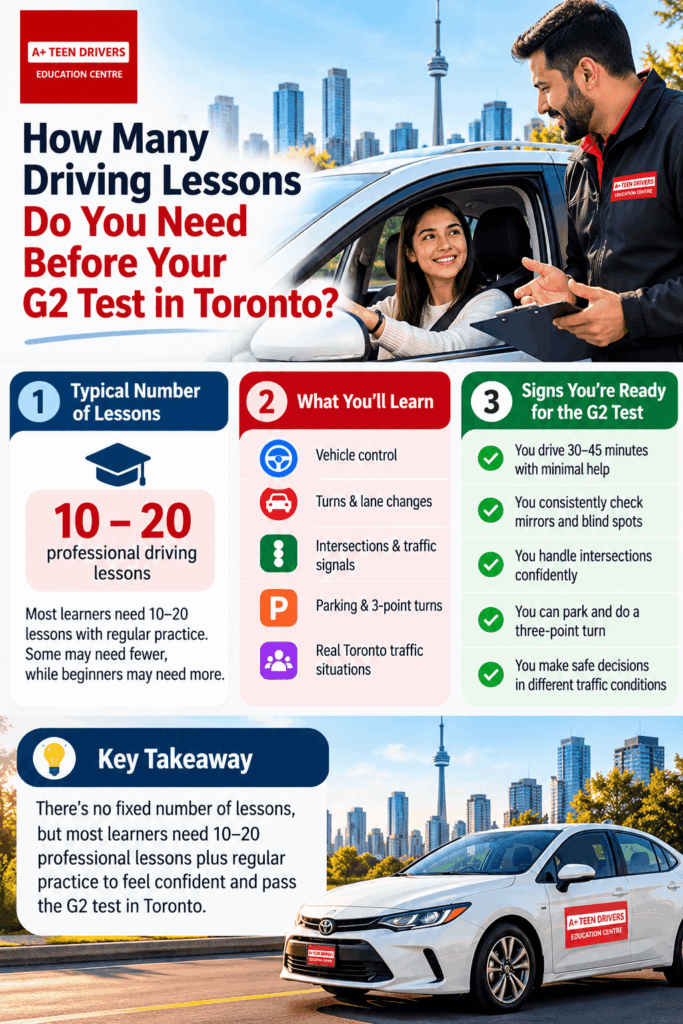
Can you drive for 30–45 minutes while your instructor mainly observes?
If your instructor still needs to give frequent instructions such as:
then more practice is probably worthwhile.
On the other hand, if your instructor can remain mostly quiet while you independently manage traffic, that is a much stronger sign of readiness.
Best Driving School Preparation Includes Mock Tests
A mock test is one of the most useful final-stage exercises.
Your instructor should behave more like a road-test examiner and give minimal assistance.
This helps identify problems that ordinary lessons can hide.
For example, a learner might perform perfectly when the instructor says:
“Get ready to change lanes.”
But during a mock test, there is no warning.
That difference matters.
A useful final preparation session can include:
The purpose is not to memorise a particular route.
It is to demonstrate that you can respond safely to changing road conditions.
Common Mistakes Learners Make Before the G2 Test
Mistake 1: Counting lessons instead of measuring ability
Completing “15 lessons” does not automatically make someone test-ready.
Skill consistency is more meaningful.
Mistake 2: Only practising the easy routes
Some learners repeatedly practise quiet neighbourhood streets because they feel comfortable there.
That can create false confidence.
Your practice should gradually include more demanding traffic environments.
Mistake 3: Memorising a test route
Learning a route can be useful for familiarity, but it should never replace genuine driving ability.
DriveTest examiners assess your driving skills, not your ability to memorise a particular sequence of streets. The official MTO guidance makes clear that the road test evaluates the actions associated with various driving tasks.
Mistake 4: Treating parking as the entire test
Parking matters, but it is only one part of overall preparation.
A learner who can parallel park perfectly but repeatedly fails to check blind spots is not fully prepared.
Mistake 5: Practising only in perfect weather
You will not always have ideal conditions after receiving your licence.
If it is safe and appropriate, supervised practice in different conditions can help build confidence.
How an Experienced Driving School Toronto Learner Can Create a Lesson Plan
Instead of booking lessons randomly, divide your preparation into three phases.
Phase 1: Skill Building
Focus on fundamentals.
Goal: Control the car confidently.
Work on:
Phase 2: Traffic Application
Apply those skills in progressively more complex environments.
Goal: Make safe decisions independently.
Work on:
Phase 3: Test Readiness
Remove instructor assistance.
Goal: Demonstrate consistency.
Work on:
This approach is generally more useful than booking the same type of lesson repeatedly.
What About a Ministry Approved Driving School Toronto?
If you are taking beginner driver education, verify that the school is actually approved by the Ontario Ministry of Transportation. Ministry Approved Driving School Toronto
Ontario states that an approved driver-education course can reduce the normal G1 waiting period from 12 months to eight months.
However, approval status and lesson quantity are two separate issues.
A ministry-approved course does not mean every learner will require exactly the same number of practical lessons.
When evaluating a school, ask:
These questions tell you more about training quality than a large advertising claim.
Choosing a Drivers Education Centre Toronto Learners Can Trust
When comparing a Drivers Education Centre Toronto learners may consider, look beyond the headline price.
A low-cost lesson is not necessarily economical if you need many additional sessions because the training lacks structure.
Likewise, the most expensive package is not automatically the best.
Look for evidence of:
The Ontario government itself recommends beginning driver training early so learners can accumulate driving experience during the G1 period.
That is an important distinction: professional instruction should complement practice, not replace it.
A Practical 15-Lesson Example
Suppose a complete beginner has access to regular supervised practice.
A reasonable structure might look like this:
Lessons 1–3:
Vehicle control, steering, stopping, basic turns and positioning.
Lessons 4–6:
Intersections, lane changes, traffic signals and residential driving.
Lessons 7–9:
Busier roads, commercial areas, parking and three-point turns.
Lessons 10–12:
More independent driving, traffic judgement and correcting recurring mistakes.
Lessons 13–14:
Mock-test preparation and targeted weak areas.
Lesson 15:
Full assessment with minimal instructor assistance.
This is only an example. If you are progressing quickly, you may need fewer sessions. If you continue making safety-related errors, adding lessons is sensible.
Expert Advice: Don’t Rush the Test Date
One of the biggest practical mistakes is booking the road test too early because of pressure from friends, family or an expiring timeline.
The better approach is to ask:
“If my instructor stopped helping me right now, could I safely complete this drive?”
If the answer is no, you probably need more preparation.
If the answer is consistently yes, and you can handle common G2 situations without reminders, you are much closer to readiness.
Also remember that eligibility requirements still matter. DriveTest states that learners generally need one year of driving experience before the G2 test, while completing an MTO-recognized driving course can reduce that period by four months.
Final Takeaway
So, how many driving lessons do you need before your G2 test in Toronto?
For many learners, 10–20 professional lessons plus regular supervised practice is a realistic planning range. Complete beginners may require more, while experienced drivers may need fewer targeted sessions.
But lesson count should never be the final measure.
The real target is consistent, independent and safe driving.
A quality Established Driving School in Toronto programme should help you progress from basic vehicle control to confident decision-making in real traffic. Whether you learn through an experienced driving school Toronto provider, an approved beginner driver education programme or another reputable training route, the objective should be the same: develop skills that remain useful after the test.
The best preparation is not learning how to “pass the route.” It is learning how to drive well enough that the test becomes a demonstration of skills you already use every time you get behind the wheel.
That is ultimately what separates simply taking driving lessons from receiving effective driving training.
Frequently Asked Questions
1. Is 10 driving lessons enough to pass the G2 test in Toronto?
It can be, but there is no guarantee. A learner who already has substantial supervised practice may become test-ready after around 10 professional lessons, particularly when those lessons are focused on specific weaknesses.
A complete beginner with limited practice may need 15, 20 or more lessons. The important measure is whether you can consistently perform the required skills without instructor prompting.
2. Should I take driving lessons every week before my G2 test?
Regular practice is generally more useful than occasional intensive lessons. Weekly professional instruction combined with supervised driving between lessons allows you to practise a skill, receive feedback and then reinforce the correction.
If lessons are separated by several weeks with little driving in between, you may spend part of every lesson rebuilding confidence rather than developing new skills.
3. What should I practise most before the G2 test?
Prioritise the skills that affect safety and overall driving performance:
Do not spend all your preparation time practising one manoeuvre simply because it feels difficult.
4. Can an experienced driver from another country need professional lessons?
Yes. Previous driving experience can reduce the amount of basic vehicle training required, but Ontario driving rules and road expectations may differ from those in another country.
A few targeted lessons with an instructor familiar with Ontario testing standards can reveal habits that an experienced driver may not recognise as problems.
5. How do I know when I am ready to book my G2 test?
A strong indicator is consistent independent driving.
You should be able to complete a mock-test-style drive without frequent reminders about mirrors, signals, speed, positioning or blind spots. You should also be able to handle normal Toronto traffic calmly and make safe decisions when conditions change. Your instructor’s assessment should support that decision rather than simply the number of lessons you have completed.

How Many Driving Lessons Do You Need Before Your G2 Test in Toronto?

How Professional Driving Instructors Help Build Confident Drivers

How to Choose the Best Driving School on St Clair: A Complete Guide


 Trustindex verifies that the original source of the review is Google.
  Trustindex verifies that the original source of the review is Google.
  Trustindex verifies that the original source of the review is Google.
 Trustindex verifies that the original source of the review is Google.
  Trustindex verifies that the original source of the review is Google.
  Trustindex verifies that the original source of the review is Google.
  Trustindex verifies that the original source of the review is Google.
  Trustindex verifies that the original source of the review is Google.
  Trustindex verifies that the original source of the review is Google.